 PhysioActive SG

 Appointments

Watch the full interview on YouTube.
My name is Kievi, and I am currently a Sport, Exercise and Health Science student at the University of Bath. I am heading into my final year.
Why I chose Physioactive
What drew me to Physioactive was the standard the clinic holds itself to. First, its physiotherapists are internationally accredited. They trained across Dutch and German systems and worked in Singapore before establishing that same standard of care in Jakarta. The breadth of services played a part too. For example, the clinic offers podiatry, women’s health, and a range of specialisms I hadn’t seen consolidated under one clinic before.
Also, I study sport science with an eye toward coaching and athlete performance. Because of this, I wanted to understand more than how a clinic treats patients. I wanted to see how a clinic of that calibre actually operates: the systems, the people, and the decisions behind the care.
What I learned from the team
My experience at Physioactive turned out to be far more valuable than I expected. This was not because of any one project. Instead, it was because of how much direct insight I received from every single person on the team.
My experience at Physioactive turned out to be far more valuable than I expected. This was not because of any one project. Instead, it was because of how much direct insight I received from every single person on the team.
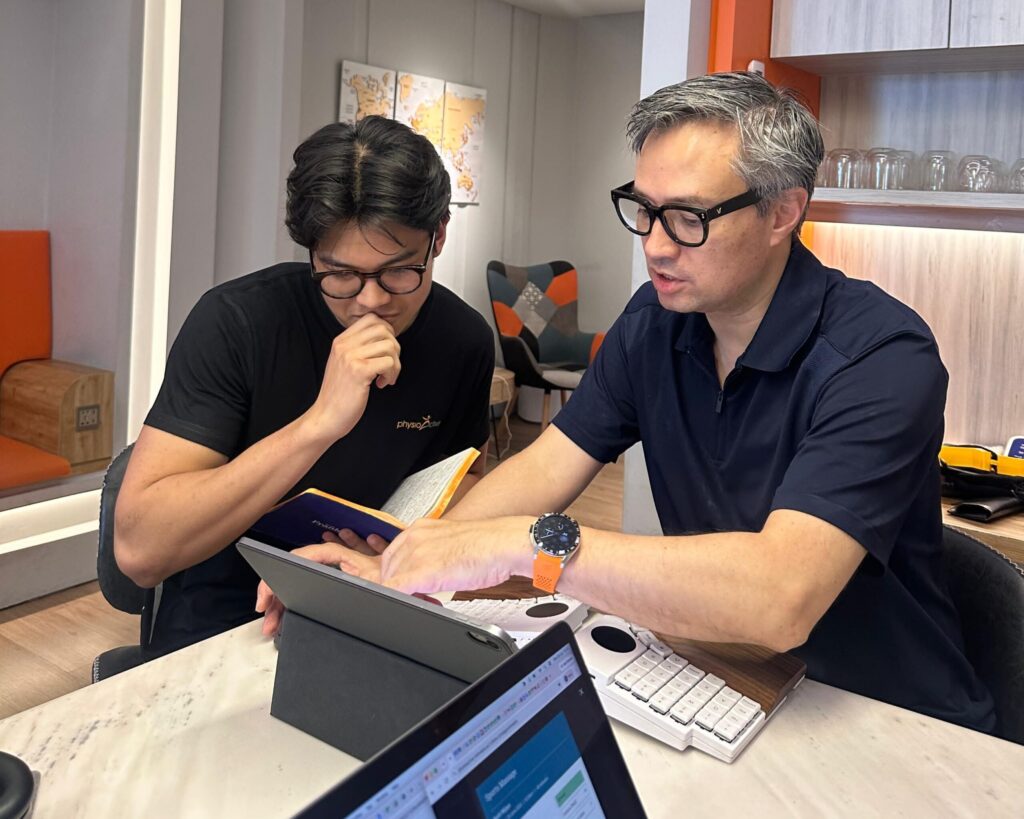
From the receptionists, I learned the systems behind booking, follow-up packages, and consultations. I also learned the front-desk logistics that quietly keep four branches running on time. From the physiotherapists, I saw the patient-handling and rehab protocols I had studied in lectures put into practice in real time.
From Bu Michelle, the owner, I learned what runs underneath all of it. This includes finance, organisational structure, leadership, licensing, and the partnerships that keep the business growing. Finally, Bapak Redmer manages the clinic’s systems. From him, I learned how data, reporting, and SEO work together to keep a modern clinic visible and efficient.
Overall, it was less an internship in one department and more a crash course in how an entire healthcare business holds itself together.
What I actually worked on
Operations & systems
A good amount of the work was unglamorous by design. It was the quiet, structural work that a business runs on, whether or not anyone notices it. For example, I built a six-week receptionist rota across the branches. This taught me that scheduling isn’t just filling a calendar. Instead, it means balancing staff availability, patient flow, and continuity of care all at once.
Managing that across one clinic is hard enough. However, doing it across four branches was even harder. Each branch had its own rhythm. This made clear how much coordination sits beneath a clinic that looks effortless from the outside.
Partnerships & compliance
I worked on hospital MOU outreach letters aimed at establishing referral partnerships. I also reviewed contracts and licensing documentation for different staff categories, such as perawat and dokter umum. In addition, I checked the various surat izin a clinic needs simply to operate legally.
Until then, I hadn’t appreciated how many regulations and roles a healthcare business has to account for. That changed when I was the one checking that the paperwork matched what Indonesian health law actually required.
Business development
I also helped prepare for a banking partnership meeting, which opened my eyes to a side of marketing I hadn’t considered — that growth doesn’t only come from digital channels. Traditional partnerships, like the kind clinics build with banks, are their own form of marketing and reach. It reframed how I think about commercial growth for a clinic altogether.
What surprised me
What truly surprised me was the freedom I was given. As an operational intern, my work could mean anything on a given day. In practice, that could mean organising logistics for a new branch or covering front-desk work. It could also mean reviewing contracts, drafting hospital outreach, or helping chase down a bank partnership.
Nothing about the role was fixed. I could have stayed in my lane and only done what I was assigned. Instead, I asked every member of the team what I could help with. That single habit opened up the entire scope of what I was able to learn.
Some days felt like an entirely different job from the day before, and I genuinely enjoyed it. Despite only being there a month, I felt real responsibility and real influence in the work I touched. It would have been a waste not to make the most of it.
Physioactive is a clinic and a business run with real care. It is intricate in how it’s organised. Yet the team is genuinely warm. They support each other and push one another to keep learning. As an intern, I thrived in that environment, and my curiosity was met at every turn.
Thank you
Thank you, Bu Michelle, for trusting me with real responsibility from the start. Bapak Redmer, thank you for patiently walking me through systems I’d never touched before. To the receptionist team and the physiotherapists: you welcomed me on day one and became close friends by the end. I’m genuinely grateful for every one-on-one conversation and every small lesson along the way.
Where this leaves me
Coming in, I wasn’t sure whether my future sat on the clinical side of sport science or the business side. Physioactive answered that question for me. It did not choose one over the other. Instead, it showed me how inseparable they really are.
As I head into my final year, I’m leaving with a much clearer sense of my direction. I want to keep working at that intersection, wherever it takes me next.